
No products in the cart.
Built to Last: Why Refurbished Rugged Laptops Make Sense
Why throwing away perfectly functional rugged hardware is wasteful and what we do about it.
The Real Waste Problem Isn’t Device Failure
Most rugged devices are not retired because they have failed. In many cases, they are removed from service due to refresh cycles, standardisation policies, or changes in procurement requirements. Hardware that still performs exactly as intended is often sidelined simply because it no longer aligns with an internal schedule.
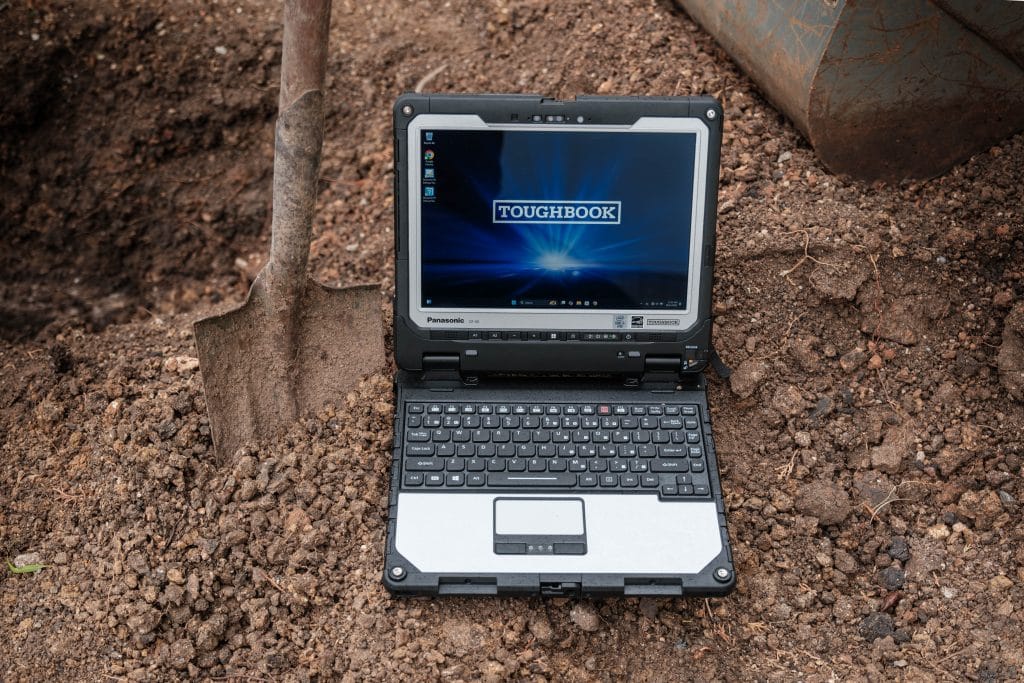
This creates a mismatch between how industrial equipment is engineered and how it is actually used. Rugged laptops are designed for long service lives, with physical durability and component tolerance far beyond consumer hardware. When those devices are retired early, the waste is not the result of degradation, but of timing.
From an engineering perspective, this is where refurbishment becomes relevant. The hardware has not reached the end of its usable life. It has simply exited its original deployment window. Extending that lifecycle does not require reinvention, only appropriate testing, validation, and re-deployment into a workload that matches the machine’s capabilities.
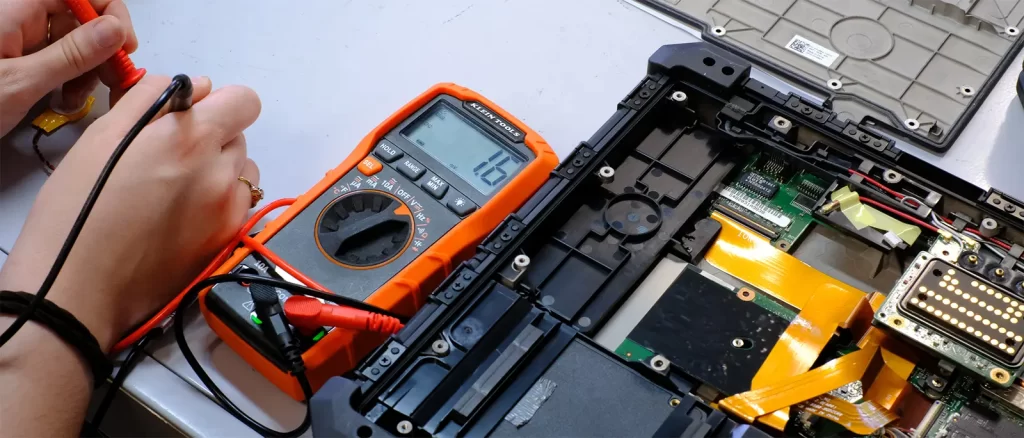
Part of our hardware reliability checks, the CMOS battery is tested before every refurbished Dell Rugged Extreme is approved.
Why Industrial Operators Don’t Always Need the Latest Model
Most industrial operators are not selecting equipment based on the newest processor generation or the thinnest chassis. Their priority is consistency. A machine that behaves the same way every day, in the same environment, with the same peripherals and software.
In many industrial workflows, laptops are validated as part of a broader system. Diagnostic tools, vehicle mounts, serial devices, and specialised software are tested and relied upon for years. Introducing new hardware purely for the sake of newer specifications can introduce compatibility issues without delivering any practical benefit in the field.
This is why older rugged models often remain in active service long after consumer devices would have been replaced. The hardware is already proven in its environment, and its performance characteristics are well understood by the people using it.
In these situations, refurbished rugged hardware becomes a practical option. It allows operators to continue using platforms that match their real-world requirements, without paying for hardware changes that do not improve reliability or outcomes.
Refurbishing Avoids the Most Harmful Part of E-Waste
The environmental impact of a laptop is heavily front-loaded during manufacturing. Raw material extraction, component fabrication, assembly, and global transport account for the majority of emissions and resource use before the device is ever deployed.
When rugged hardware is retired early, that embedded cost is effectively written off. Replacing a device that is still fit for purpose repeats the most resource-intensive part of the lifecycle, even if the replacement offers little or no improvement for the work being done.
Extending the service life of industrial equipment delays the need for new manufacturing altogether. In practical terms, refurbishment is not about improving efficiency or reducing consumption. It is about continuing to use hardware that was engineered to last, rather than discarding it before its useful life has ended.
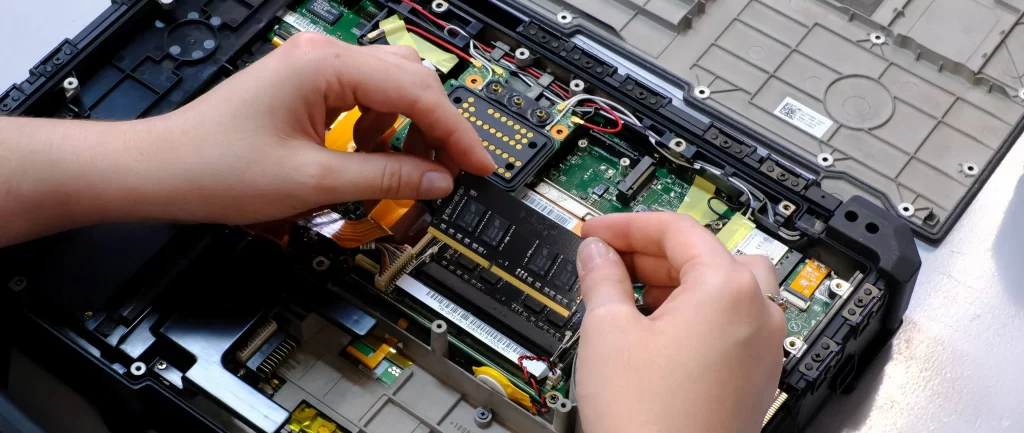
Installing upgraded memory in a Dell Rugged Extreme, a common part of our customisable refurbishment process.
What Refurbishment Actually Delivers
A proper refurbishment restores a rugged laptop to dependable working condition by focusing on the components and systems that determine reliability in the field. This typically includes storage and memory upgrades, thermal servicing, power and battery checks, port and module testing, firmware updates, and full functional diagnostics.
The goal is not to modernise the platform or chase the latest specifications. It is to ensure the hardware performs consistently in the environment it was designed for. Cosmetic wear may remain, and the processor generation may not be current, but those factors have little impact on most industrial workloads.
When refurbishment is done correctly, the outcome is a machine that behaves predictably under load, powers on reliably, and continues to operate in conditions that would quickly degrade consumer-grade equipment.
The Business Case for Refurbished (Beyond E-Waste)
Reducing unnecessary waste is a benefit of refurbishment, but it is rarely the primary driver for industrial operators. In practice, the decision to deploy refurbished rugged hardware is usually based on cost efficiency, operational reliability, and long-term serviceability.
Refurbished rugged laptops typically offer significant cost savings compared to new equipment, while retaining the same physical durability and environmental tolerance. When the hardware already meets the performance requirements of the workload, paying for a newer generation platform often provides little practical return.
Operationally, refurbished hardware also supports continuity. Many industrial environments rely on established software, peripherals, and mounting systems that are already validated on specific models. Maintaining that consistency reduces retraining, compatibility issues, and downtime.
Finally, refurbishment enables continued access to parts and service for platforms that may no longer be available new. For operators running stable, long-term deployments, this ongoing support is often more valuable than access to the latest hardware release.
When Refurbished Makes Sense (And When It Doesn’t)
Refurbished rugged hardware is well suited to environments where workloads are stable, software requirements are known, and reliability matters more than having the latest specifications. It is particularly effective in field operations, diagnostics, and industrial applications where the hardware platform has already proven itself over time.
It is also a practical option when a specific model is required for compatibility with existing peripherals, mounting systems, or validated software. In these cases, continuity and predictability are often more valuable than incremental performance improvements offered by newer platforms.
Refurbished equipment may be less appropriate where workloads genuinely require the latest processor architectures, or where deployments are mission-critical with no tolerance for unplanned downtime. In those scenarios, operators may prefer new hardware to align with support contracts, warranty structures, or internal policies.
The trade-offs are generally straightforward: older processor generations, some cosmetic wear, and limited model availability compared to new equipment. Where these factors do not affect the actual work being done, refurbished rugged hardware remains a reliable and cost-effective choice.
Browse Refurbished Rugged Laptops
If you need rugged hardware for field work, diagnostics, or outdoor use, refurbished units offer proven reliability without unnecessary replacement. Every system we supply is tested thoroughly and can be configured to suit your application.
View Refurbished Range